

Learn about
2030 Agenda for Sustainable Development
and Cannabis.
The Cannabis Embassy’s Ministry of Internal Affairs (MINTA) has published 6 articles about Cannabis & 2030 Agenda for Sustainable Development.
Legatio Cannabis
大麻大使馆
سفارة القنب

The 2030 Agenda for Sustainable Development, adopted by all UN Member States in 2015, sets out 17 Sustainable Development Goals (SDGs) and 169 targets addressing poverty, health, education, gender equality, decent work, climate, biodiversity, peace, and international cooperation. It is the closest thing the world has to a shared, universal roadmap for the coming decades.
Cannabis is not a footnote to this agenda — it runs through it. As a plant cultivated across every continent, entangled with questions of poverty and rural livelihoods, health and harm reduction, gender, biodiversity, traditional knowledge, criminal justice, and climate resilience, cannabis policy directly shapes progress (or setbacks) on dozens of SDG targets. The Cannabis Embassy’s work at the United Nations — from the Commission on Narcotic Drugs to UNESCO’s Mondiacult and the 2030 Agenda review processes — treats sustainable development not as a separate silo from drug policy, but as the framework within which cannabis policy should be designed, debated, and evaluated.
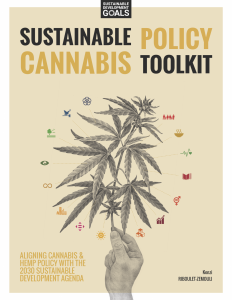
Read the toolkit:
This topic is handled by the Cannabis Embassy’s Ministry of Internal Affairs
The Ministry of Internal Affairs (MINTA) is in charge of everything internal to the Cannabis Embassy. The MINTA is part of the Government of the Cannabis Embassy and is composed by the following subsidiary bodies:
- CENGGA (Cannabis Embassy’s Non-profit Groups and Grassroots Associations)
- CEPSAC (Cannabis Embassy’s Private Sector Advisory Council)
- Council on Embassy Finances & Administration
- Constitutional Council
- Library & Archive (Bibliothecas Archivumque ex Legationis Cannabis)
Bodies not yet formally constituted: Council on Communications; Council on Justice & Human Rights. Body suspended: Strategic Planning Commission.
UNESCO Contribution – Cannabis: A Plant Without Borders. Cultural Diagnosis, One Hundred Years After Its Prohibition
UNESCO Conference on Cultural Policies and Sustainable Development + World Indigenous Peoples Day + Centenary of Cannabis Prohibition
Cannabis & Sustainable Development – the Policy Toolkit
Advocacy History: International Cannabis Advocacy 1998–2024